
My First World Diamond Congress, Part Two
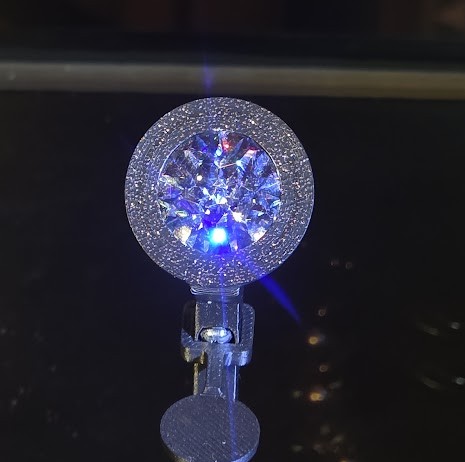
the same object at the center of every conversation on day two.
Day two at the World Diamond Congress 2026 started with a question I hadn’t expected to be asking by lunchtime: why does a 3.5-billion-year-old object need help telling its own story?
I’d walked into the congress thinking of natural diamonds as a settled category: old, rare, beautiful, done. What I got instead was a room full of people who’ve realized that “old, rare, beautiful” isn’t a marketing plan. It’s a fact. And facts, it turns out, don’t sell themselves anymore.
The trust problem, from the top
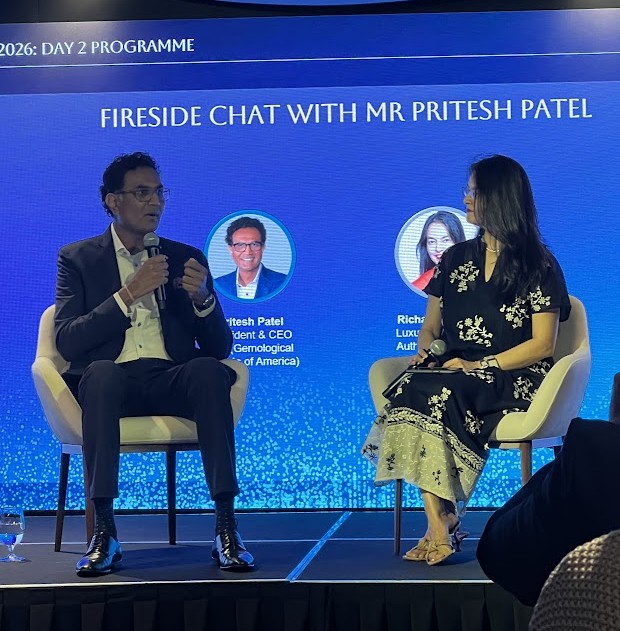
The day’s first session set the tone without meaning to. Pritesh Patel, GIA’s President and CEO, sat down for a fireside chat and named three shifts reshaping the industry: trust, technology, and a widening global wealth gap forcing every institution to rethink who they’re actually serving. GIA’s own five-year plan, timed to the organization’s centennial, comes down to one line: future ready, anchored in science, empowered by technology, trusted by consumers globally. What stuck with me was the sentence underneath it. Patel put it simply: the founders built GIA to solve the problems of their era. His job is to solve the problems of this one.
One piece of that is GIA’s roughly 30% stake in Tracr, the blockchain traceability platform, an investment in future consumer confidence rather than a tech play. GIA’s role is governance: bringing neutrality to a platform that only works if the whole industry trusts it equally. Other companies are expected to join as owners over the next few years, alongside an MoU with Serene to extend traceability into manufacturing.
It’s a quiet answer to a loud problem. And the loud problem is what the rest of the day was actually about.
Diamond versus diamond
Here’s the sentence that reframed the whole day for me, from the “Defense to Offense” panel: consumers now face diamond vs. diamond, not diamond vs. simulant.
For most of natural diamond’s history, the competition was obviously fake. Cubic zirconia. Glass. Something a jeweler could catch under a loupe in five seconds. That’s not the fight anymore. Lab-grown stones are, chemically, physically, optically, the same material. The FTC said so itself, back in 2018. Once that’s true, the only variable left standing is price, and lab-grown wins on price every time, unless something else gets said out loud.
The panel called it the three-pillar framework: price, story, contribution. Lab-grown owns the first pillar outright. But natural diamonds have the other two almost entirely to themselves: the forever journey a stone took to reach a counter, and the human and environmental contribution behind it. Story and contribution aren’t decoration, they’re what makes the price make sense. Without them, someone paying more for a natural stone is just paying more.
That’s where the Four Revelations came in, a thirty-second script built for the counter, and I wrote all four down word for word because they’re genuinely disarming: Diamonds form roughly 100 miles underground, deeper than any drill has ever reached. Most formed before continents as we know them existed, so a diamond genuinely has no country of origin at the moment of its birth. An average stone is 2 billion years old, which makes a T. Rex thirty times closer in time to your iPhone than to the diamond in your hand. And if you compressed a diamond’s life into one human lifespan, humans showed up four days ago, and all of recorded history fits inside the final hour.
Someone on the panel closed with a line about synthetic moon rock: it costs about ten dollars a bag, and nobody’s ever tried to protect it federally. You can replicate the chemistry. You can’t replicate the journey.
Teaching the room to say it
The panel before this one, “Building Natural Diamond Demand Worldwide,” had circled the same problem from a different angle: how do you get hundreds of thousands of retail associates, most of whom have never heard the phrase “forever journey,” to deliver a story like that with any confidence?
Part of the answer is that the cultural work has to happen long before the counter. By the time a consumer walks into a store, they’ve mostly already decided what they want, the room compared it to Chanel, where desire gets seeded years in advance. Gen Z buyers are finding that desire on Reddit, on TikTok, through AI-assisted search, peer to peer, and top-down advertising tends to produce rejection rather than resonance.
One stat stopped me: a retailer reported a 115% increase in sales of K-to-O color diamonds, the warmer, less “perfect” stones, over just two years. Flawless is losing. Distinctive is winning. As one panelist put it: nobody wants a diamond that feels manufactured for $500 and shipped from China. They want one that feels like them.
On lab-grown specifically, the advice was consistent and a little counterintuitive: don’t attack it. Use the word “synthetic” plainly, because it’s accurate, then say clearly what a lab-grown stone cannot claim: age, uniqueness, provenance, a one-of-a-kind story. One panelist described a customer offered a two-carat lab-grown diamond for $800 against a $10,000 budget, who said no. It’s not special. That was reason enough.
The honest caveat: none of this works at the very low end of the market, where the price gap is too large to talk away at a counter. The fix there isn’t a better sales script, it’s the cultural work upstream.
Turning the story into something you can’t fake
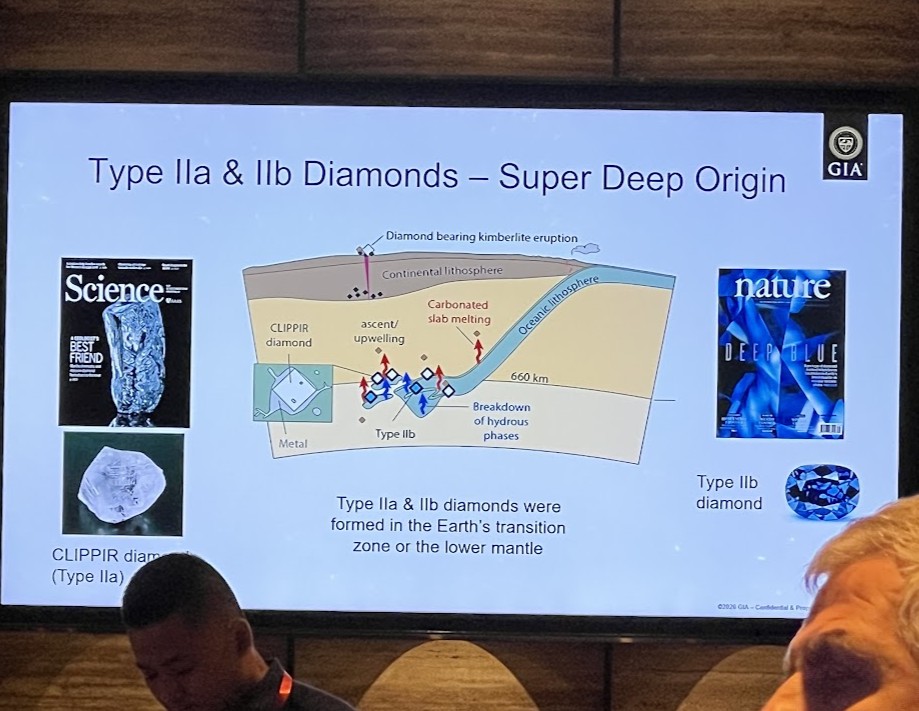
By early afternoon, the day shifted from why the story matters to how you prove it’s true. Dr. Wuyi Wang from GIA opened with a fact that made the room go quiet: 98% of diamonds enter the Earth’s mantle looking black. Over millions of years, defects inside them (a stray nitrogen atom, a missing carbon atom) reorganize, and the stone becomes transparent or takes on color. Nitrogen makes yellow. A vacancy makes blue. Nitrogen and a vacancy together make pink. No two diamonds share the same defect pattern, genuinely unique down to the atomic level, and that’s the literal scientific foundation GIA’s origin-verification service is built on.
Most diamonds form 150 to 200 kilometers down. The rare 2%, including the largest and most commercially significant stones, form as deep as 800 kilometers. Dated through radioactive decay in trapped mineral inclusions, they range from about 650 million to 3.5 billion years old, on a planet that’s 4.6 billion years old itself. A single stone takes tens of millions of years to crystallize, and needs a kimberlite eruption to reach the surface fast enough, too slow, and it reverts to graphite.
One detail I keep returning to: a ringwoodite inclusion in a single Brazilian diamond contained 1.4% water, suggesting the Earth’s transition zone might hold as much water as every ocean on the surface combined. A diamond isn’t just old. It’s a message in a bottle from a part of the Earth we’ll never visit.
Wang added something that quietly justified the rest of the day: GIA cannot determine a faceted diamond’s geographic origin through analysis alone. Unlike a ruby or sapphire, where mineral traces suggest a likely source, a cut diamond’s birthplace can only be tracked if someone started tracking it at the mine.
Tagging a stone that’s a billion years old
The nanoparticle and AI panel felt like two people solving the same problem from opposite ends.
Dr. Daniel Nyfeler from Gübelin Gem Lab described a technology built with ETH Zurich researchers: DNA encoded into silica nanoparticles, 80 to 100 nanometers wide, carrying a mine name, exact location, and mining period. It started with emeralds, whose natural fissures trap the particles well, Kagem, the world’s largest emerald mine, was the pilot site, and roughly a fifth of high-quality emerald production now carries these tags. On diamonds, working with a Surat manufacturer, the technology is applied after cutting to survive the acid-boiling cleaning process. Cost: one to two-and-a-half dollars a carat, cheap enough for melee stones.
Janak Mistry of DiaDNA is solving a different problem: not where a stone came from, but whether it’s still the same stone. A rough diamond passes through more than seventy hands over roughly forty days, and every handoff is a chance for a swap. One color grade lost means 15 to 30% of the stone’s value gone, and human vigilance teams are bad at catching it. One company ran twelve evaluators for eighteen months and caught nothing. The month after installing DiaDNA’s scanner, they caught three people responsible for fifteen switches.
The technology matches a polished stone to its rough origin using a unique atomic and inclusion signature, almost like a paternity test, trained on 200,000 diamonds and tens of millions of data points. Accuracy has climbed from 60% to 82% since launch.
What I didn’t expect was how directly this tied to Africa. Gübelin is working with Ethiopia’s Ministry of Mines, after Ethiopian emeralds were smuggled out through Djibouti and Somalia and resold as Colombian or Zambian stones. Botswana and Angola representatives were reportedly in the room too, interested in building national diamond brands of their own. Provenance isn’t just a science problem. It’s a sovereignty problem.
Making sure the story stays honest
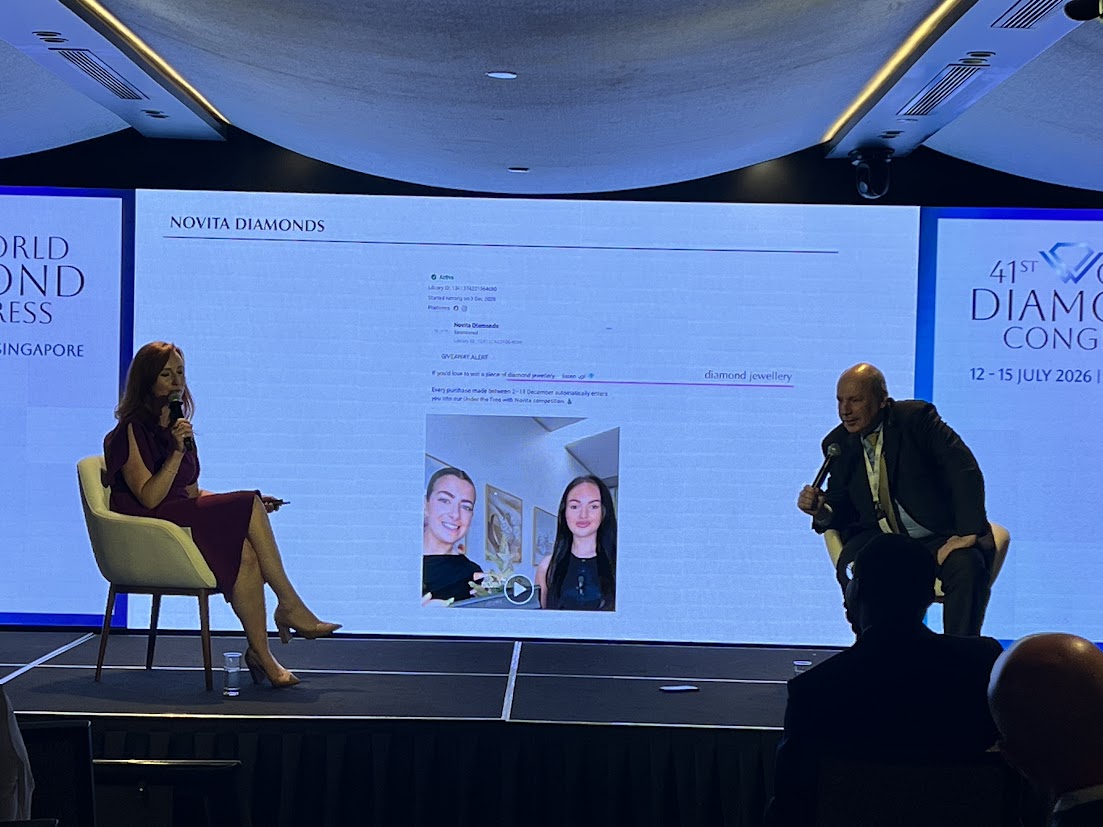
The day’s final panel was the necessary hard edge on everything before it. If the industry spends this much energy building a true story, someone has to stop people from telling a false one.
Raluca Anghel from the NDC walked through the rules, stricter than I’d assumed: a synthetic diamond must be disclosed at every touchpoint, not just at the register. “Diamond,” used alone, always means natural. Words like “real,” “authentic,” and “precious” are off-limits for synthetics. A hashtag buried in a caption doesn’t count as disclosure, and neither does an invoice line after the sale.
Two examples stuck with me. Novita Diamonds, a UK jeweler, ran an Instagram giveaway for “diamond jewellery” while selling only undisclosed synthetics. A major US department store labeled display cases “diamonds” over inventory that was almost entirely synthetic, until the NDC intervened directly. The environmental claims get the same scrutiny: “carbon neutral” requires actual reporting on energy use, and vague terms like “eco-friendly” don’t pass regulatory muster in the US, UK, or India without numbers behind them.
The story the whole day had been building, ancient, provenance-verified, ethically sourced, only means something if the industry holds itself to the same standard it’s asking consumers to believe in.
What I took from day two

the real work of the congress happening just as much in the hallways as on stage.
I came in thinking a diamond’s value was self-evident — you either see it or you don’t. What day two actually taught me is that self-evident things still need someone to say them out loud, and say them accurately, at exactly the moment someone’s deciding whether to spend real money.
The story was always there. Billions of years underground, water trapped inside stones from a part of the planet we’ll never reach, defect patterns unique down to the atom. What’s new is the realization that none of it counts unless it survives the last eighteen inches — the actual distance across a jewelry counter, where a nervous buyer is standing across from someone who may only have thirty seconds and one good sentence to work with.
By the end of the day, I understood Patel’s line differently than I had that morning. The founders solved the problems of their era. This generation’s problem isn’t proving diamonds are old. It’s proving, to a skeptical and very online buyer, that old still means something.
